Titanic Historical Society Commutator 250
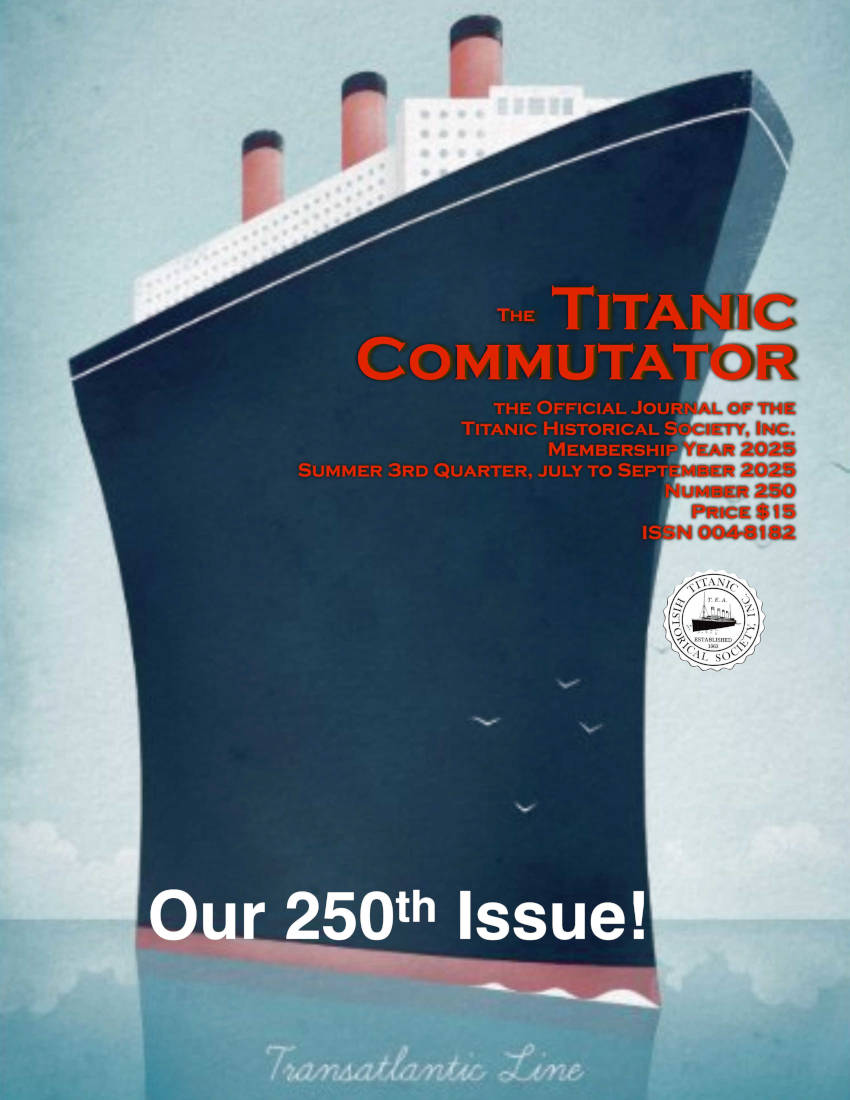
THS Commutator No. 250, Summer 3rd Quarter, July to September 2025
Contents
Sinking of the Arabic
On Arabic’s final voyage, she left Liverpool on Wednesday afternoon, August 18, 1915, for New York with 424 aboard including a crew of
181. Built by Harland & Wolff and laid down in 1902 as Minnewaska (II) for the Atlantic Transport Line, the unfinished ship was transferred to the White Star Line when Atlantic Transport was taken over by the International Mercantile Marine Company.
A Second Look by Patrick Stenson
From trials after the disaster using Titanic’s near identical twin sister ship, Olympic it was calculated that when Officer of the Watch Murdoch first gave the hard-a-starboard command, Titanic was between 400 and 450 yards from the iceberg. From this it was worked out that she turned two points to port as she struck the ice 37 seconds later.
Titanic’s Gus “The Cat” Cohen The Man With Nine Lives by Edward Kamuda
Throughout his life, accident-prone Gus, regularly cheated death. His first brush with Fate was when he was emigrating to America at age 19 sailing on Titanic. Not only did he survive the sinking, Gus was wounded twice in World War 1––in the Somme in 1916, “…being shot in the back of the head and below my left eye of which I am blind in this eye”, “…bombed twice–– hitting his home and “…a direct hit on my business from German bombs…” in World War II, “…also went out the wrong side of a train in the ‘Black Out’” and fell on the track, survived rheumatic fever at age 43, broke his wrist three times and his ribs twice, and hit by a car resulting with a fractured skull as he walked to a television station in Dublin to tell about his Titanic experiences
Book Review- Inside the Britannic by Simon Mills by Ray Lepien
She Saw the Titanic Go Down by “Echo” Shipping Reporter.
“We saw the Titanic go down and even when she was below the water some of the lights still showed. Our boat was just far enough away to be clear of the suction. We were rescued at 8:30 the following morning by the carpathia which landed us at New York. We lost
everything, but fortunately my mother’s future employer was there to meet us.”
British Sailors Training for the Mercantile Marine in Titanic’s Era
What was required to become an officer on a large ocean liner in 1912? Where did he go to learn? How did he gain practical experience?
Young men who intended to become officers of the mercantile marine were encouraged, if possible, to join a training ship. For the well-to-do there was the Conway in the Mersey near Liverpool, and the Worcester which was in the Thames off Greenhithe. Both were formerly wooden steam warships, and under the command of naval officers. The instructors were largely drawn from naval sources and both vessels had facilities for sending cadets to the Royal Naval College at Osborne.
Oceanic House by Paul Louden Brown
The development of steamship travel during the Edwardian era was a golden period of expansion for many shipping lines, including the White Star Line. The Company’s purchase by American financial interests in 1902 resulted in new energy and drive directed into every aspect of the Company’s operations and renewed focus given to their long standing rivalry with Cunard. White Star, like its principal rival and many other long established shipping lines, was Liverpool based. The Company’s headquarters building at 30 James Street, designed by leading British architect Richard Norman Shaw (1831-1912), opened for business in 1898.